
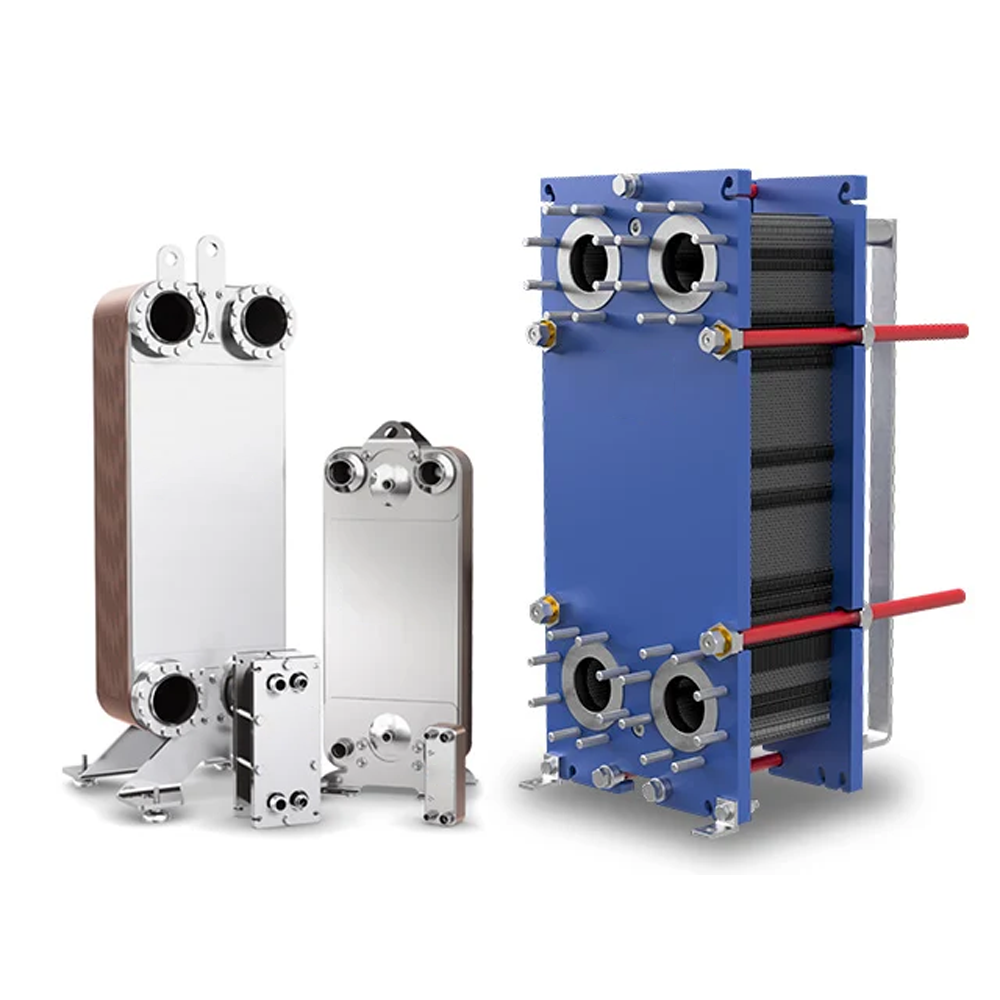
Heat exchangers on request
Steiner Ukraine designs and configures plate heat exchangers to suit the specifications of a particular system. We do not simply select the closest match from an existing catalogue; instead, we design the heat exchanger to suit your media, flow rates, inlet and outlet temperatures, and permissible head loss, and supply it fully assembled.
How do plate heat exchangers differ from shell-and-tube heat exchangers?
The heat transfer surface in a plate heat exchanger is formed by a stack of corrugated plates. The fluids flow in counter-current through the narrow channels between them; the corrugations create turbulence even at low velocities, and the heat transfer coefficient is several times higher than in a shell-and-tube heat exchanger of the same capacity.
There are three practical implications. Footprint: for the same heat load, a plate-type heat exchanger takes up several times less space. Temperature drop: the difference between the media at the outlet can be several degrees, which is not achievable with a shell-and-tube design. Maintenance: the demountable unit can be opened, the plates cleaned mechanically, and the capacity adjusted by adding or removing plates without having to replace the entire unit.
Shell-and-tube heat exchangers remain suitable where pressure or temperature exceeds the limits of gasketed designs, as well as in heavily contaminated media containing large particles.
What types of plate heat exchangers are there?
The design is determined by the environment and operating conditions.
Dismantlable with gaskets — a stack of plates clamped within a frame, with gaskets fitted around the perimeter of each plate. They can be opened for cleaning, and the capacity is adjusted by changing the plates. This is the standard design for water, brines and foodstuffs.
Semi-welded – the plates are welded in pairs, with gaskets left only between the pairs. These are used when one of the media is incompatible with the gasket material, for example in refrigeration circuits.
Soldered units — a package soldered into a single block, without gaskets or a frame. They are compact and can withstand higher pressures, but cannot be dismantled, so they require a clean environment or on-site flushing.
Welded — a fully welded assembly designed for corrosive environments and high temperatures, where gaskets are not suitable.
The choice between them is made prior to the calculation, as both the permissible pressure and the method of subsequent maintenance depend on it.
What data is required to calculate plate heat exchangers?
A bespoke calculation begins with information about the system. The more comprehensive the data collected, the more accurately the set of plates is selected and the less spare capacity is built into the machine.
You need to know: the media on both sides and their properties; the flow rate for each circuit; the inlet and outlet temperatures on each side; the permissible head loss; the design pressure and design temperature; the material requirements for the plates and gaskets; any requirements regarding contact with foodstuffs; the type and size of connections; and the spatial constraints of the installation site.
The environment’s susceptibility to contamination is taken into account separately. It determines the surface reserve and the service interval: a unit designed without this reserve will require flushing sooner than specified in the manufacturing specifications.
If any data is missing, we will determine it together with you based on the installation diagram and the actual operating conditions.
How we work on a heat exchanger to order
First, you submit an enquiry via the form on this page or by telephone, providing whatever details you have.
Next, we analyse the operating conditions: we check the thermal load, agree on the type of structure and materials, and refine the input data where necessary.
We then carry out the calculation and provide a proposal setting out the package configuration, cost and lead time. The unit is supplied fully assembled and ready for connection.
Where are plate heat exchangers used?
We work with the energy, chemical and food industries, HVAC systems and other sectors.
Typical applications vary in their requirements, and this influences the design. In the power industry and at heat distribution centres, pressure and thermal stress are the primary considerations. In food production, the focus is on materials in contact with the product, ease of dismantling and cleaning, and documentation for gaskets. In chemical processes, the focus is on the compatibility of materials with the process medium. In HVAC, the focus is on dimensions and pressure drop, as the unit is integrated into an existing circuit with a specified pump.
Industry-specific problems are described in the section sector-specific solutions.
Plates, gaskets and maintenance
The service life of the disassemblable unit is determined by two consumable components: the gaskets and the plates themselves.
Seals deteriorate due to temperature and environmental factors, and are replaced in accordance with maintenance schedules rather than when a leak actually occurs. The plates lose thickness due to corrosion and erosion, and their channels become clogged with deposits, which are removed by flushing or mechanical cleaning during dismantling.
Therefore, when designing a unit to specification, we immediately record which plates and gaskets are used in it. This makes it possible to order a replacement kit without having to dismantle the unit to identify the type.
Other items in this group can be found in the section heat exchangers and in the catalogue technological equipment. Steiner Ukraine has been operating in the industrial equipment market since 2006.
Frequently Asked Questions
In which sectors are your plate heat exchangers suitable for use?
We work with the energy, chemical and food industries, as well as the HVAC sector and other sectors. The design and materials are determined by the environment and operating conditions of the specific installation.
In what ways is a plate heat exchanger better than a shell-and-tube heat exchanger?
For the same heat output, it is more compact, results in a smaller temperature difference between the media and can be opened for cleaning. A shell-and-tube heat exchanger is selected when the pressure or temperature exceeds the limits of a gasketed design, and for highly contaminated media.
What data is required for the calculation?
The media on both sides, the flow rate in each circuit, the inlet and outlet temperatures, permissible head losses, design pressure and temperature, requirements for materials and connections, and dimensional constraints. If any of this information is missing, we will determine it together with you.
Is it possible to change the capacity of a ready-made heat exchanger?
In the detachable version — yes, by adding or removing plates within the frame. In the brazed and welded versions, the assembly remains unchanged.
How long does it take to produce?
Usually between 2 and 6 weeks, depending on the complexity of the project.
What is the warranty for the equipment?
One year’s warranty on custom-made heat exchangers.
Do you supply plates and gaskets separately?
Yes. For the units we have designed, the type of plates and gaskets is fixed, so a replacement set can be selected without dismantling the unit.