Hidrostal – screw centrifugal pumps in four designs (End Suction Volute)
The Hidrostal submersible pump belongs to the End Suction Volute group of pumps with a volute casing and a screw-centrifugal impeller. This is the largest group in the manufacturer's range in terms of the number of designs and sales volume. It includes four types: compact, submersible, semi-submersible, and bearing bracket mounted. The operating principle of the screw-centrifugal impeller is described on the brand page Hidrostal.
Four designs of the volute casing pump
All four types use the exact same hydraulics. The difference lies in the drive, cooling, and installation method.
| Implementation | Capacity | Pressure | Power | Tubing |
|---|---|---|---|---|
| Compact | 0.8–24.6 l/s (2.9–88.6 m³/h) | 0.5–17.7 m | 0.1–2.4 kW | 50–80 mm |
| Submersible | up to 2,500 l/s (9,000 m³/h) | up to 100 m | 0.55–400 kW | pressure 50–700 mm |
| Semi-submersible | 0.5–3000 l/s (1.8–10,800 m³/h) | 0.5–90 m | 0.1–650 kW | discharge 50–700 mm, suction 65–700 mm |
| On the bearing support | 0.5–3000 l/s (1.8–10,800 m³/h) | 0.5–90 m | 0.1–650 kW | 32–700 mm |
For all executions: 50 Hz, 60 Hz power supply or via frequency converter; wetted parts materials — cast iron, ductile iron, Hi-Chrome, stainless steel, duplex steel.
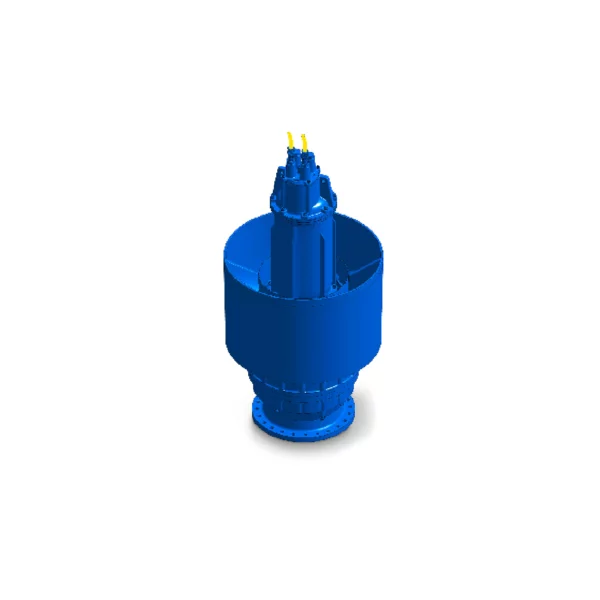
Hidrostal submersible pump: cooling by the pumped medium
Submersible operation works continuously submerged. The motor is cooled by the liquid in which it is immersed. Installation is vertical.
The manufacturer designs and manufactures these engines itself. The unit is assembled as a single assembly: there are no exposed rotating shafts or couplings.
| Parameter | Value |
|---|---|
| Capacity | up to 2,500 l/s (9,000 m³/h) |
| Pressure | up to 100 m |
| Power | 0.55–400 kW |
| Pressure pipe | 50–700 mm |
| Power supply | 50 Hz, 60 Hz, frequency converter |
The manufacturer highlights as features of this design efficient cooling, which reduces the thermal load on the motor and the casing surface temperature, quiet operation, simple installation and lifting of the unit, as well as a wide range of control and protection options.
The pump is designed for sewage with a high content of solid and fibrous particles, for viscous liquids, and for media that require delicate handling.
Semi-submersible pump: dry and wet sump operation
The semi-submersible design (immersible) features an independent closed-circuit cooling system. The motor does not use the pumped medium for cooling, so the cooling channel does not become fouled with deposits and overheating does not occur as a result.
The same pump gives identical performance in air, partially or fully submerged. This removes restrictions on the water level in the sump.
For dry installation, the manufacturer lists the following properties: flood protection, vertical or horizontal mounting, compactness, quiet operation, cold outer casing surface, no product leakage, no exposed shafts and couplings, and simple pump opening for inspection.
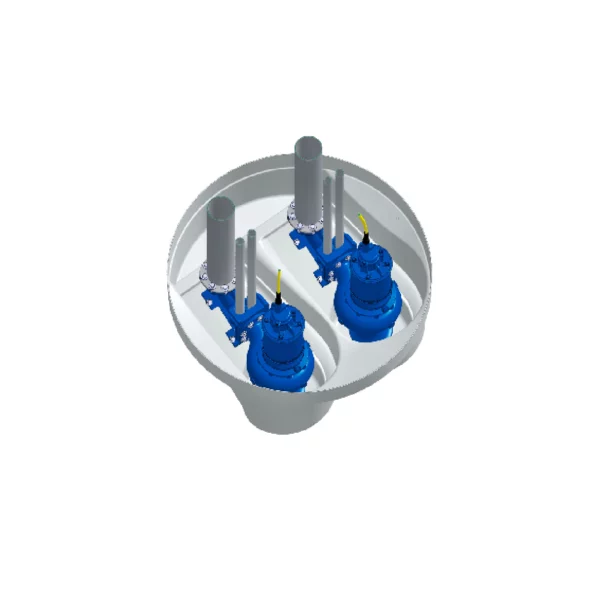
During wet installation, the pump is mounted in the same way as a submersible pump. The liquid level can be lowered to the pump casing without the risk of motor overheating, so the sump turns out shallower than for a conventional submersible pump.
The execution works with viscous liquids, fragile activated sludge flakes and live fish. Motors of the Tuma range are available for this execution.
Compact portable pump
The compact pump weighs 23 kg including the 5m cable. This is a field unit for rapid deployment: emergency services, fire brigades, construction sites, private households.
| Parameter | Value |
|---|---|
| Capacity | 0.8–24.6 l/s (2.9–88.6 m³/h) |
| Pressure | 0.5–17.7 m |
| Power | 0.1–2.4 kW |
| Tubing | 50–80 mm |
| Clear access | 50–75 mm |
| Mass | 23 kg with 5 m cable |
| Engine efficiency | to a level equivalent to IE3 |
| Gaskets | double mechanical seal |
| Voltage | 3 phases: 380, 400, 415, 460, 480, 575 V |
| Explosion-proof version | available |
The characteristic is steep, so the pump has a margin of pressure and power when switching to a more viscous medium. The power curve is non-overloading.
Typical applications: industrial wastewater, viscous sludge, return activated sludge, drainage, process waste, pit cleaning, construction sites, flood protection.
Pumps on a bearing support: three connection schemes
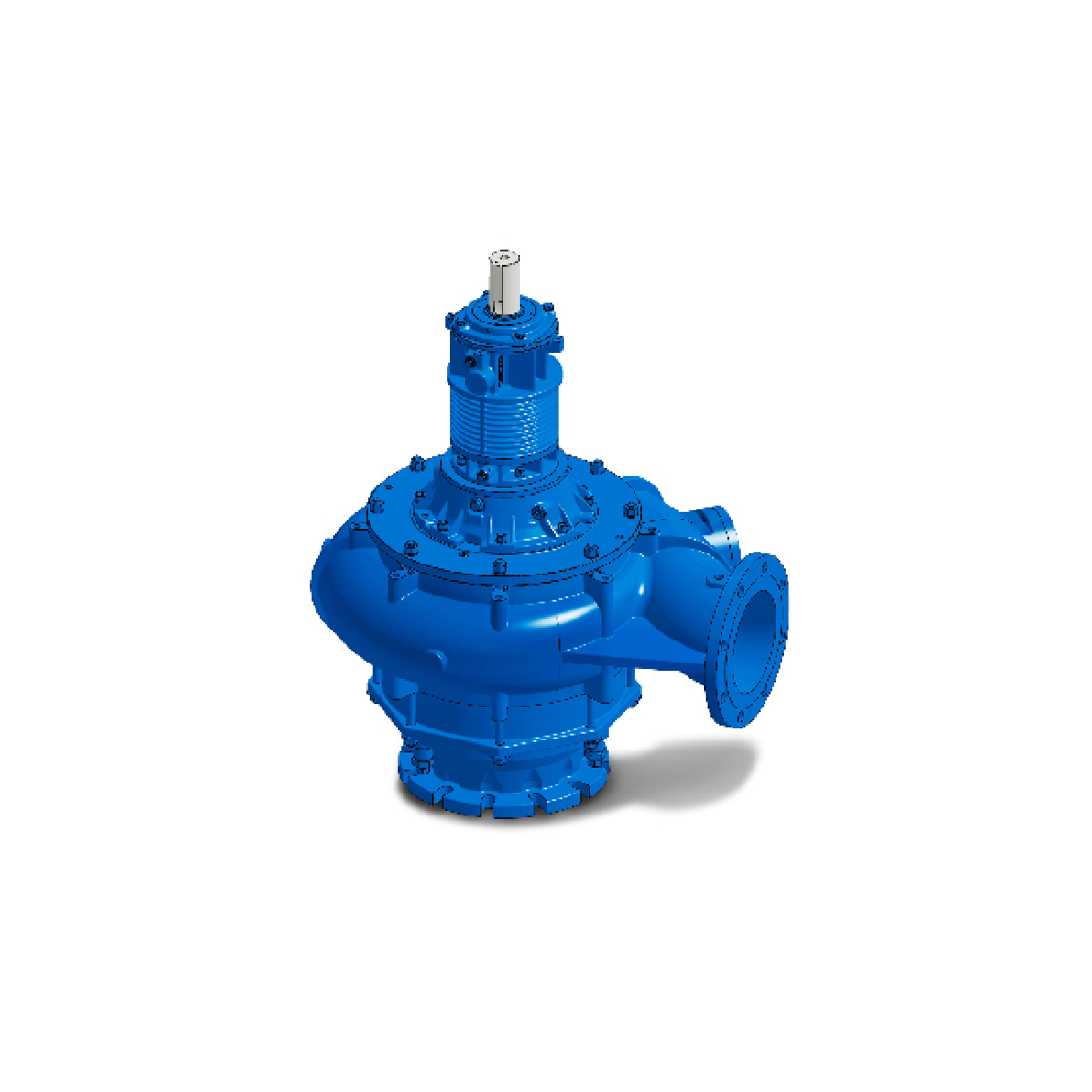
This execution is intended for dry installation only and requires an external drive. The manufacturer offers three designs, each suitable for horizontal and vertical mounting.
Direct coupled The flanged motor is centered directly on the bearing bracket, which eliminates shaft misalignment. A flexible coupling is additionally installed. Back pull-out design: the rotating assembly together with the motor is pulled out for inspection of the hydraulic part. Discharge nozzles 50–700 mm.
Close coupled The same bearing assembly, but with a free shaft end. Discharge branches 50–700 mm.
Long coupling Classic layout. Bearings are greased as standard; oil lubrication is available for horizontal units in process industries. The bearing housing is modular, allowing for various mechanical seal options.
| Parameter | Value |
|---|---|
| Tubing | 32–700 mm (1.5–28″) |
| Capacity | 0.5–3000 l/s (1.8–10,800 m³/h) |
| Pressure | 0.5–90 m |
| Power | 0.1–650 kW |
Advantages cited by the manufacturer: direct access to the pump and devices, cleanroom maintenance, the ability to use standard drive components, back pull-out design, and heavy-duty bearings with a high calculated L-10 service life for both direct and belt drives.
Typical applications: industrial wastewater, untreated sewage without screens, viscous sludge, returned activated sludge, drainage and storm water, process waste, sump cleaning, bacterial flocs, live fish, fruit and vegetables.
How to choose a Hidrostal submersible pump for an application?
Continuous operation below the liquid level in a sewage pumping station — submersible execution. The motor is cooled by the medium; a stable minimum immersion level is required.
A variable level or the requirement to work in both dry and wet sumps points to a semi-submersible design. This also results in a shallower sump and access to the pump without dewatering.
Dry machinery hall with access to equipment, standard IEC motor, belt or direct drive — pump on a bearing bracket.
Temporary work, emergency pumping, transferring between sites — a compact pump.
Frequently asked questions about the Hidrostal submersible pump
What is the maximum flow rate?
2500 l/s (9000 m³/h) for submersible design and 3000 l/s (10,800 m³/h) for semi-submersible and bearing-supported design.
What is the maximum head?
Up to 100 m for submersible execution. Semi-submersible and bearing-supported - up to 90 m, compact - up to 17.7 m.
How does a semi-submersible pump differ from a submersible one?
The submersible type is cooled by the pumped medium and operates submerged. The semi-submersible type has its own closed cooling circuit and works equally well in air, partially or fully submerged.
Can the level in the sump be lowered to the pump casing?
For the semi-submerged version — yes, without the risk of motor overheating. That is precisely why the sump turns out shallower than for a standard submersible pump.
Is there an explosion-proof version?
The manufacturer indicates the availability of Ex-proof versions for compact pumps. For other versions, availability is to be confirmed upon selection.
What wetted materials are available?
Cast iron, ductile iron, high-chrome, stainless steel, duplex steel.
Can live fish and foodstuffs be pumped?
Live fish are listed among typical applications for semi-submersible and bearing-bracket pumps, and fruit and vegetables for bearing-bracket pumps. Material specification and documentation for a specific medium are agreed separately.
What is needed for the selection?
Design flow rate, head, medium characteristics and size of inclusions, type of installation (wet, dry, portable), drive type, operating mode, material and condition monitoring requirements.