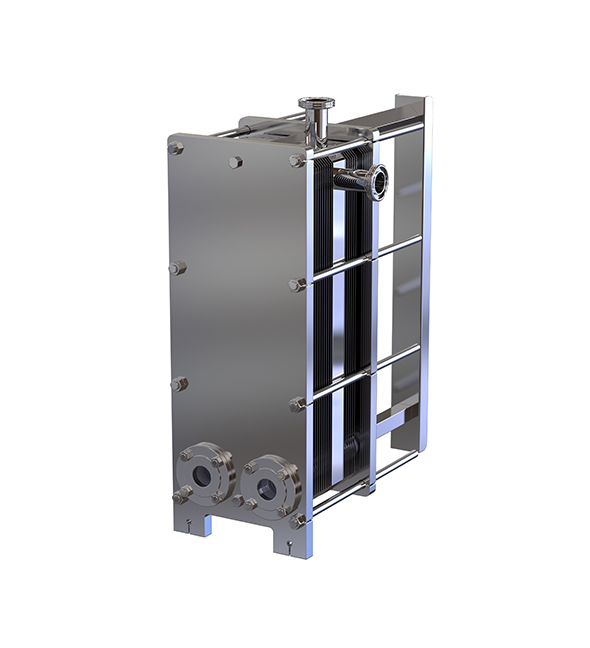
The TMXFLOW stainless steel heat exchanger is designed for processes where corrosion resistance and hygiene matter. The housing and plates are made of stainless steel, so the unit handles aggressive liquids and demanding operating conditions.
It is used in the food and beverage, chemical and pharmaceutical industries and in power generation. The general working principle of plate heat exchangers is described on the page TMXFLOW – Heat Exchangers.
Why a stainless steel heat exchanger?
In food production the heat exchanger is in contact with the product and cleaning solutions. The material must not corrode and must be easy to clean.
Stainless steel withstands regular CIP cleaning with caustic and acid. How to organise cleaning without stopping production is described in the article on CIP cleaning of equipment.
Main characteristics
| Parameter |
Value |
| Type |
plate |
| Housing and plate material |
stainless steel |
| Implementation |
hygienic |
| Media |
food products, beverages, aggressive liquids |
| Flow arrangement |
counterflow |
Where is the TMXFLOW stainless steel heat exchanger used?
- pasteurisation and sterilisation of food products and beverages;
- cooling of finished product;
- heating and cooling in chemical processes;
- pharmaceutical processes with surface cleanliness requirements;
- power generation and industrial process lines.
How to choose a stainless steel heat exchanger for your product?
Selection requires the media on both sides, flow rates, inlet and outlet temperatures, allowable pressure drop, operating pressure and cleaning regime.
For products with fibres or sediment, channel width and corrugation type are important. For heat-sensitive products — flow uniformity and accurate temperature control.
How to maintain the unit in operation?
Regular CIP cleaning does not replace scheduled inspection. During maintenance the condition of the plates, tightness of joints and absence of deposits in the channels are checked.
Signs that the unit needs maintenance:
- the pressure drop between inlet and outlet increases;
- the product at the outlet does not reach the set temperature;
- leaks appear.
More details — in the article on signs of heat exchanger wear.
Spare parts and service
Steiner Ukraine supplies heat exchanger parts and performs regeneration on site and at the service centre. What a plant risks when choosing between original and non-original parts is described in the article «Original or non-original spare parts».
The heat exchanger price is quoted on request after a thermal calculation.
FAQ
Is this unit suitable for food products?
Yes. It is used for pasteurisation, sterilisation and cooling of products and beverages.
Can the heat exchanger be CIP-cleaned?
Yes. Stainless steel is resistant to alkaline and acid cleaning solutions.
Does the heat exchanger handle aggressive liquids?
Yes. The stainless steel housing and plates are highly resistant to aggressive liquids. The material is confirmed during selection for the specific medium.
What is needed for the selection?
Media, flow rates, inlet and outlet temperatures, allowable pressure drop, operating pressure and cleaning regime.