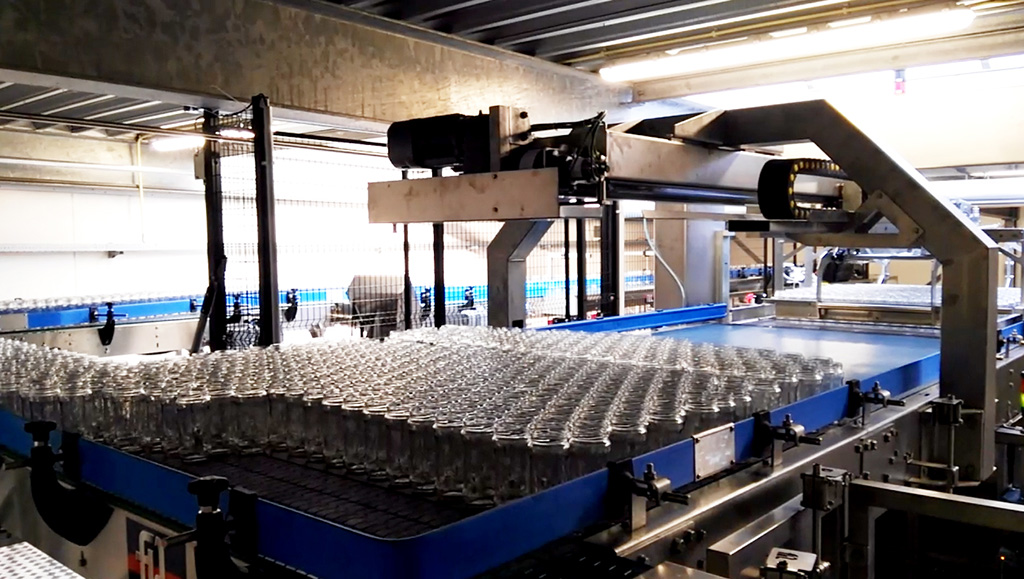
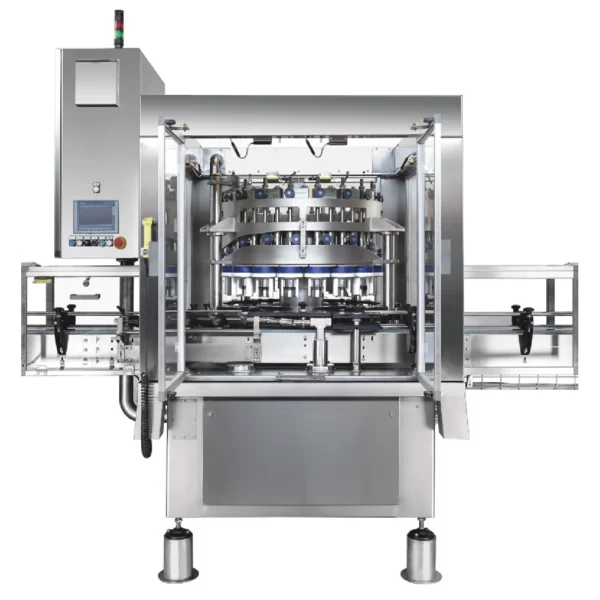
The FBL depalletizer unloads pallets of glass jars and bottles of various shapes or of cylindrical tin-plate cans and feeds the containers to the packaging line. The FL-018 range includes semi-automatic, automatic and robotic models with top or bottom feeding. The manufacturer and all equipment are described on the FBL brand page.
Which FBL depalletizer models are in the range?
| Model |
Mode |
Feeding |
Features |
| FL-018 |
semi-automatic |
from the bottom |
layers unloaded at line height, pads removed by the operator, accumulation table |
| FL-018-S-V |
semi-automatic |
from the top |
automatic pad removal, light signal before the last pad |
| FL-018-S-V_POL |
semi-automatic |
from the top |
as FL-018-S-V, plus a whole-layer unloading table |
| FL-018-S-V POL |
automatic |
from the top |
pallet input chain conveyor, two side magazines for pads and empty pallets |
| FL-018 with magnetic head |
automatic |
— |
magnetic head for full and empty tin-plate cans, whole-layer unloading table |
| FL-018 robotic |
automatic |
— |
anthropomorphic robot, sealed jars, tin-plate cans and bundles |
All models have a control board with a touchscreen panel.
How does the automatic FBL depalletizer work?
The operator places full pallets on the input chain conveyor and removes the film. After the cycle starts, the machine moves to the working position and feeds the pallet to the unloading station.
The machine then feeds the jars to the line layer by layer. It stacks pads and empty pallets in two side magazines.
How do the semi-automatic models differ?
In top-feed models, the operator places the pallet on the loading platform with a pallet truck or forklift. The machine removes the pads between layers automatically, and a light signal warns about the last pad.
In the bottom-feed FL-018 model, layers are unloaded at line height and pads are removed by the operator.
What can the robotic FBL depalletizer do?
- the robot is fitted with different grippers depending on the product;
- it combines with suction-cup pad removal systems and pallet handling systems;
- conveyors for input and output pallets;
- pad and pallet columns with supply magazines;
- safety guards with an access door and light barriers.
How to select an FBL depalletizer?
According to the manufacturer's general brochure, FBL depalletizers handle from 1,000 to 60,000 bottles and up to 160,000 cans per hour. The specific model is chosen by capacity, flexibility and line layout.
- You provide the input data: container type and size, pallet dimensions, layer pattern, required capacity and level of automation.
- Steiner Ukraine, together with the manufacturer, selects the model and configuration.
- You receive a commercial offer. The price depends on the model and configuration.
After depalletizing, containers are cleaned by FBL container processing machines.
Frequently asked questions
Which containers do FBL depalletizers unload?
Glass jars and bottles of various shapes and cylindrical tin-plate cans; the robotic model also handles sealed jars and bundles.
How does top feeding differ from bottom feeding?
In top-feed models, pads are removed automatically. In the bottom-feed FL-018 model, layers are unloaded at line height and pads are removed by the operator.
Is the depalletizer suitable for tin-plate cans?
Yes. The FL-018 with magnetic head handles full and empty tin-plate cans.
What does the operator do on the automatic model?
Places full pallets on the input conveyor and removes the film. The machine feeds jars to the line and stacks pads and empty pallets on its own.
How much does an FBL depalletizer cost?
The price is provided on request. It depends on the model and configuration.