
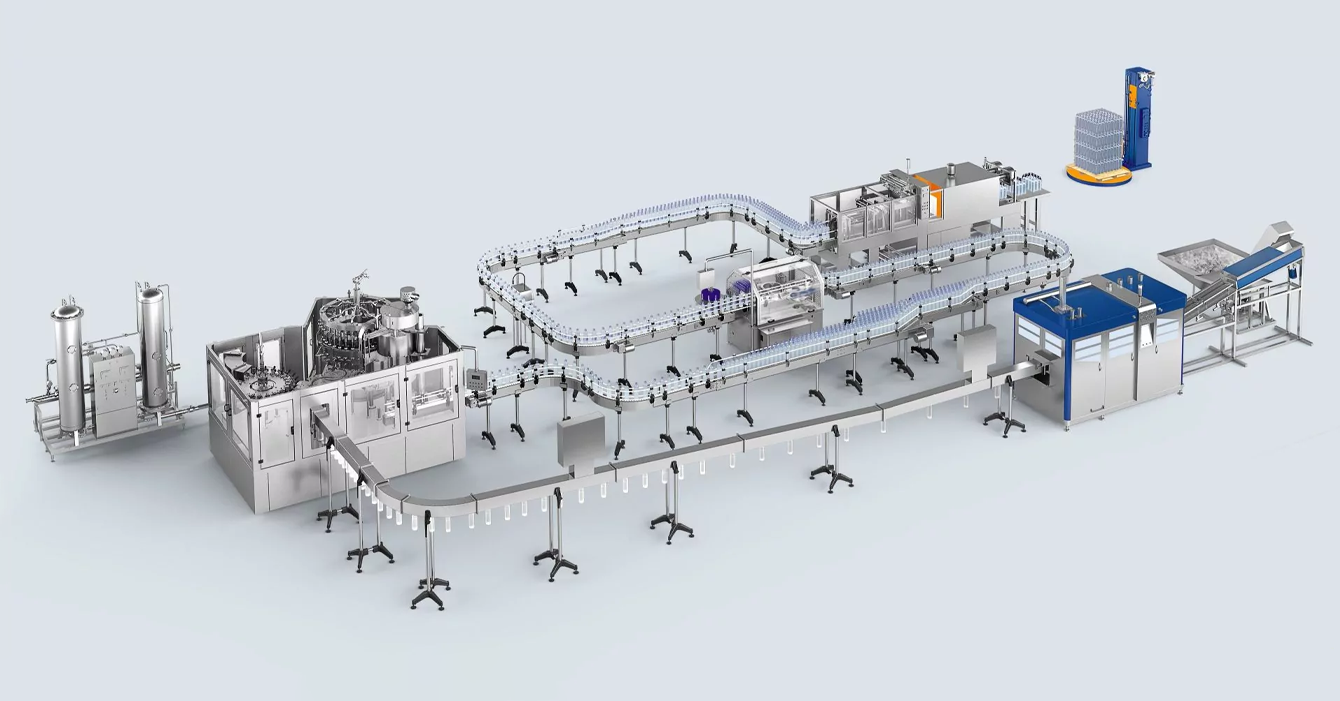
Downtime on bottling lines is rarely accidental. In most cases, it is the result of a series of engineering decisions made without taking into account the actual dynamics of the process. The line may appear to be technically sound, but it is operating at the limits of its capacity, and in such a state, even the slightest deviation can quickly lead to a shutdown.
The key issue is that a bottling line is often viewed as a collection of individual machines. In reality, it is a single system with strong interdependencies between its components. The failure or degradation of a single component always propagates further down the line. And the higher the production speed, the less resilient the system becomes to localised faults.
Equipment not suited to actual operating conditions
One of the most common causes of downtime is a mismatch between the actual operating conditions and those for which the equipment was designed. This is not always a gross error. More often, it is the result of gradual changes in the process:
- other packaging;
- new product;
- increased productivity;
- a change in the temperature or viscosity of the liquid.
The equipment may technically be able to cope with the new parameters, but it will be operating under excessive load. For example, a pump or dosing unit may start operating at the limits of its capacity. This leads to accelerated wear of the seals. The conveyor operates with a higher torque than intended. And the valves open under increased pressure.
Such deviations rarely cause an immediate failure. Instead, they create underlying instability. The line continues to operate, but there is an increase in the number of micro-stops, operator interventions and minor failures. Over time, this develops into regular downtime, which comes to be seen as ‘normal’. In reality, however, it is a systemic design flaw.
Loss of synchronisation between nodes
A bottling line is only effective when all its components operate in perfect synchronisation. Even a slight difference in speed between modules can cause a build-up or a break in the flow. Buffer zones temporarily mitigate the problem, but do not resolve it.
A classic example is an imbalance between the filling and capping units. If one module operates faster, containers start to pile up; conversely, ‘downtime’ occurs. This leads to:
- emergency stops;
- sensor malfunction;
- mechanical distortions.
In the long term, a loss of synchronisation leads to the deterioration of the entire line. Mechanical wear increases. Positioning accuracy declines. Product quality deteriorates. And, most importantly, operators begin to compensate for the problem through manual intervention, which further reduces the system’s stability.
The quality of consumables and packaging
A separate category of causes for bottling line downtime is not related to the equipment itself, but to what passes through it. Containers, lids, film and labels are often regarded as secondary factors. In reality, however, they are responsible for a significant proportion of breakdowns.
Minor deviations in bottle geometry or material stiffness can cause grippers, centring devices and dispensers to malfunction. Caps with inconsistent tightening torque cause problems at the capping stations. Film with uneven thickness causes malfunctions in the heat tunnels.
The problem is compounded by the fact that these factors often vary from batch to batch. The line is set to ‘average’ parameters, but actual conditions constantly deviate from these. As a result, the system operates in a constant compensation mode, which is one of the typical causes of downtime on bottling lines.
The human factor as a key variable
Despite automation, the operator remains a critical component of the production line. Yet it is precisely here that many hidden causes of downtime arise. More often than not, these are not errors, but necessary adjustments to account for imperfections in the process.
The operator begins to adjust the settings ‘by ear’, ‘by eye’ or based on their own experience. This results in non-standard operating modes. When staff change, these settings are lost. The line reverts to its default state, which no longer corresponds to actual conditions.
The result is an unstable system that depends on specific individuals rather than technical parameters. Such production lines exhibit significant variations in productivity and quality. And any absence of a key operator leads to increased downtime.
The consequences of systemic errors
The main problem with downtime lies not in the stoppages themselves, but in their cumulative effect. Every unscheduled stoppage disrupts the production rhythm. Taken together, however, they create an unstable production process that is difficult to predict and plan for.
An unstable production line requires larger stocks of raw materials, spare parts and additional staff. The proportion of defective products is rising. Equipment utilisation rates are falling. Yet management often sees only the symptoms, not the root causes.
From an engineering perspective, most downtime is not caused by technical failures, but is the result of incorrect or outdated decisions. A bottling line should be viewed as a dynamic process that requires regular analysis, adaptation and optimisation. Otherwise, it will inevitably deteriorate, even if all the individual machines are technically in working order.
That is precisely why an analysis of the causes of downtime on bottling lines should not begin with individual stoppages, but with an assessment of the system as a whole. It is important to understand how the process behaves under load, where bottlenecks arise, and which solutions have, over time, begun to undermine production stability.


