
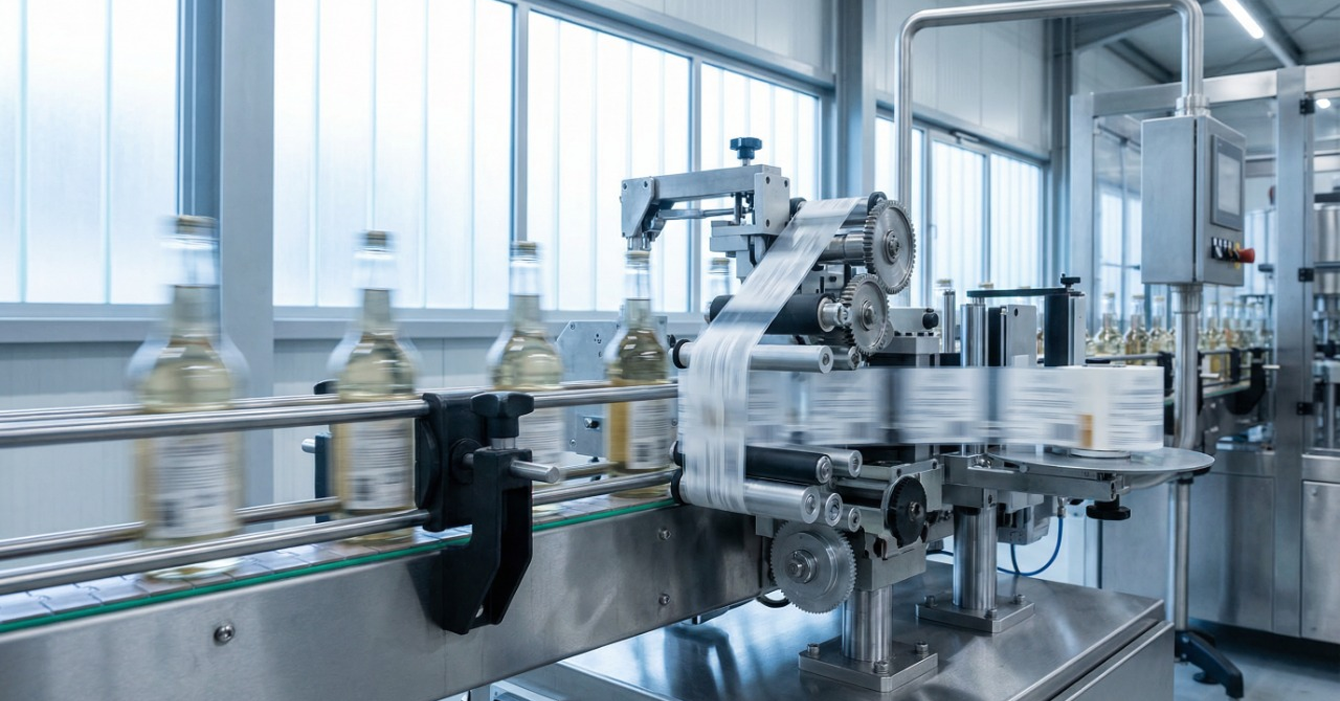
In most manufacturing facilities, automatic labelling machines have long been regarded as the final and technically straightforward stage. That is, until problems start to pile up right here: inconsistent speed, label misalignment, and quality depending on the operator. And then it becomes clear that the choice of labelling technology directly affects the stability of the entire production line.
This is no coincidence, but rather the point where all the instabilities of the process converge:
- container behaviour
- fluctuations in speed
- the effect of temperature and humidity
- the difference between batches of materials
And this is where it becomes clear that the ‘labelling machine’ is not a single technology, but rather several fundamentally different approaches.
Why are most faults not down to the equipment?
When a business is looking for labelling equipment, the reasoning is usually quite straightforward:
→ compare cars
→ check the speed
→ select the “best”
The problem is that different automatic labelling machines operate on different physical principles.
And these principles:
- react differently to instability
- scale differently in terms of speed
- have different effects on the cost price
In other words, the question isn’t ‘which machine is better’, but rather: which technology is best suited to your process?
What technologies are actually being used?
Four approaches currently dominate the field of industrial labelling:
1. Self-adhesive (automatic self-adhesive labelling machines)
The label already has an adhesive layer and is applied without additional operations.
It provides flexibility and precision, but shifts responsibility for stability to the materials and operating conditions.
2. Cold glue
A classic technology for mass production.
It offers low operating cost, but works consistently only under controlled conditions.
3. Roll-fed (roll-fed systems)
A technology for high-speed lines, where the label is fed from a roll and applied in synchronization with the line.
A standard for beverage production.
4. Hot melt (hot glue)
Uses hot-melt adhesive for rapid fixation.
Provides stability at high volumes, but requires extremely precise process control.
5. Sleeve (heat-shrink tubing)
The label is applied in the form of a sleeve and then shrinks under the effect of temperature after application.
It makes it possible to cover the entire surface of the package, but requires stable container geometry and precise control of the temperature regime.
6. Combined systems
Combine several labeling technologies within one machine or line.
They provide flexibility when working with different formats and products, but make the system more complex and increase the requirements for setup and maintenance.
In most manufacturing processes, the actual choice comes down to these two technologies.
Where does the difficulty of choosing actually lie
On paper, all technologies ‘work’; it is in practice that the differences become apparent.
One technology → provides stability at speed, but → sacrifices flexibility
The other → can be easily adapted to a new product, but → becomes expensive when scaled up
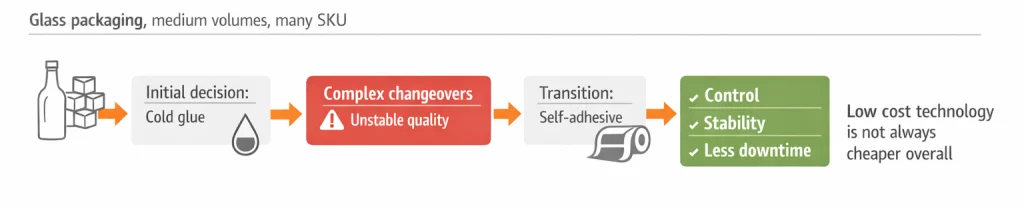
The third option → appears cost-effective, but → results in losses due to instability
And that is precisely why most mistakes stem not from choosing the wrong equipment, but from selecting the wrong technology.
Example: when universality doesn’t work

Example: when cost savings do not scale
What the right approach looks like
In practice, the choice of technology is not simply selected from a catalogue; it is based on:
- actual line speed
- container stability
- number of formats
- production conditions
- design requirements
Only then does it make sense to look at specific automatic labelling machines.
Automatic labelling machines: what comes next after choosing the technology
In this series, we have examined each technology individually, not from the perspective of ‘how it works’, but from the perspective of how it performs in production:
👉 Self-adhesive: where it offers control, and where it incurs costs
👉 Cold glue: when the economy is doing well, and when it isn’t
👉 Roll-fed: how to achieve stability at speed
👉 Hot melt: where process discipline is essential
👉 Sleeve: when design and finish matter more than simplicity
Automatic labelling machines are not just about the equipment itself. It is about choosing a technology that:
- reflects the actual conditions
- does not cause hidden losses
- and produces the expected result
And it is precisely this difference between ‘works’ and ‘works reliably’ that determines the effectiveness of the entire line.
What to do next
If these brief overviews have given you a general understanding, that’s a good first step. But in reality, decisions always come down to the specifics:
- how the packaging behaves
- what is the actual speed
- what are the environmental restrictions
- where losses are currently occurring
It is these details that determine the choice.
If you need help sorting out your situation, the experts at Steiner Ukraine can step in and guide you through it:
- analyse the line
- identify bottlenecks
- select the most suitable technology
There are no one-size-fits-all answers; only what works for you in your production environment.


