
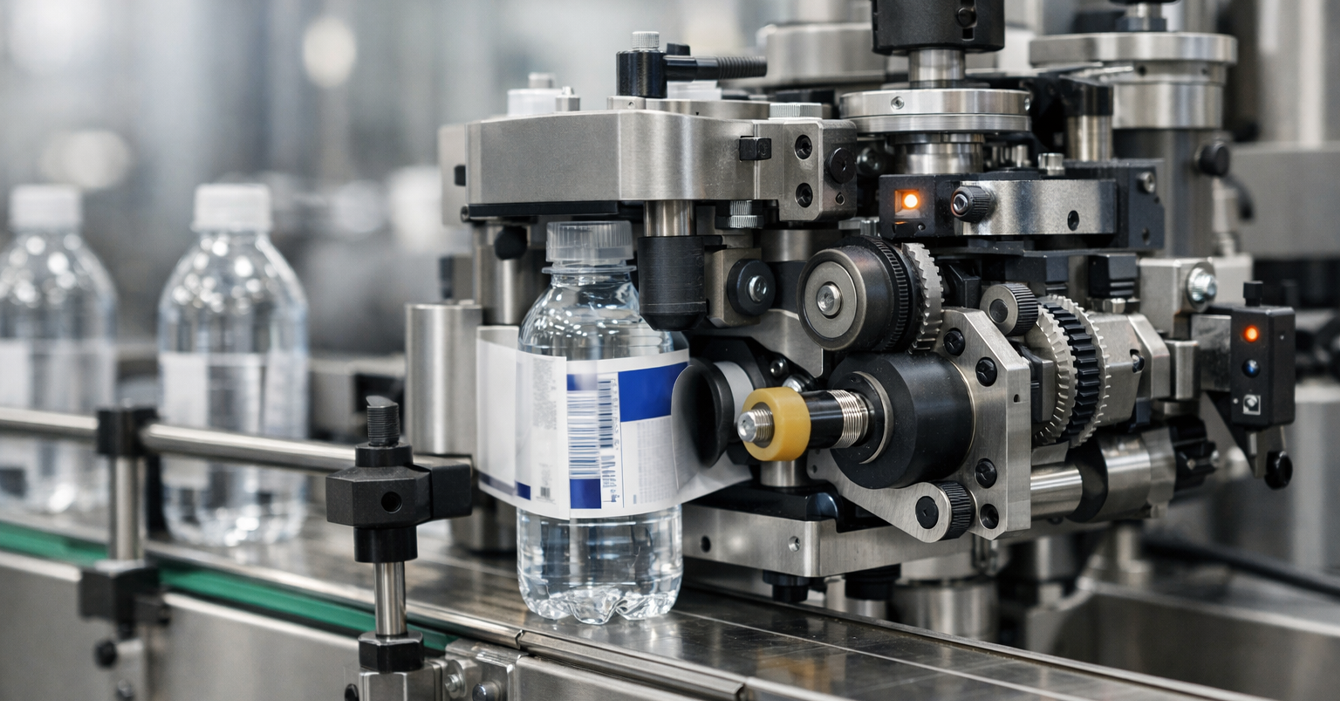
Self-adhesive labeling is often perceived as a “safe choice.” The technology appears universal: it does not require glue on the line, provides high positioning accuracy, and is easily adaptable to different formats. That is why it is often the first option considered when the task is to purchase labeling equipment.
But under real production conditions, the key question is different: does this technology provide process control, or does it simply shift problems to another part of the system?
How Self-adhesive Labeling Works in Practice
Formally, the process looks simple: a label with pre-applied adhesive is fed from the liner and applied to the product.
In practice, process stability depends on three things:
- Consistent supply of containers
- The quality of the label itself (adhesive + substrate)
- The condition of the packaging surface (moisture, temperature, product residue)
And this is exactly where the difference begins between “it works” and “it works consistently.”
Self-adhesive labeling has no built-in compensation mechanism; it does not “correct” instability, but responds to it directly.
Where This Technology Delivers Maximum Efficiency
Self-adhesive labeling delivers the best results not where things are “complicated,” but where controllability and flexibility are required. As a rule, these are production environments with the following characteristics:
- a large number of SKUs
- regular format changes
- various packaging designs
- requirements for precise positioning (front/back, transparent labels)
Under these circumstances, alternative technologies either lose accuracy or become too complicated to reconfigure.
EXAMPLE: when flexibility is more important than cost
Cosmetics manufacturing, ~20 SKUs, small batches.
Problem:
when using adhesive systems:
- lengthy reconfigurations
- unstable positioning on complex packaging
Solution:
switch to self-adhesive labelling machines
Result:
- reduction in changeover time
- consistent positioning
- the ability to work with different types of labels without changing the technology
In this case, flexibility is more important than the cost of the label.
Where the limitations begin (and why they aren’t mentioned in the catalogues)
The main issue with self-adhesive materials is not technical, but rather economic and process-related.
1. Cost of consumables
Self-adhesive labels are more expensive than adhesive solutions. When dealing with large volumes, this amounts not to a mere ‘5%’ increase, but to a significant cost factor. This is particularly noticeable on products with low profit margins.
2. Sensitivity to conditions
Self-adhesive is highly sensitive to:
- condensate (cold-fill)
- a damp surface
- product residues
In other words, the problem often lies not with the machine itself, but with the preceding stage (filling/cooling).
3. Dependence on label quality
Unlike adhesive systems, where part of the process is controlled by a machine, here everything is ‘built into’ the label.
An unstable batch = an unstable process.
EXAMPLE: when self-adhesive causes hidden losses
Beverage production, average rate.
Problem:
- periodic peeling
- inconsistent adhesion
Reason:
- condensate after bottling
- the adhesive is unsuitable for the conditions
Solution:
- not a replacement car
- and a review of the technology (partly involving a switch to a different type of labelling)
Conclusion:
The technology was chosen without taking the conditions into account; it wasn’t that the equipment was ‘bad’.
When self-adhesive is the right choice
This technology is justified if:
- the production facility works with various formats
- high positioning accuracy is required
- it is important to adapt quickly to the new product
- the volumes involved do not make the cost of the label a critical factor
In these circumstances, it provides a level of control that is difficult to achieve by other means.
When to consider alternatives
- volumes are high and production costs are critical
- the packaging is consistent and does not change
- there are issues with humidity / temperature
- the line is operating at full capacity
In such cases, roll-fed or hot-melt printing often produces a more consistent and cost-effective result.
Practical conclusion
Self-adhesive labelling machines are not a ‘one-size-fits-all solution’, but rather a tool designed for a specific type of production.
They offer maximum flexibility and control, but shift the responsibility for stability to:
- label quality
- conditions on the line
- product preparation
And this is precisely where the line is drawn between an effective system and the constant minor issues that ‘eat away’ at productivity.


