
Irrigation is once again becoming one of the key tools for stabilising agricultural production in Ukraine. But the reasons for this go much deeper than just climate fluctuations.
In 2023, after the destruction of the Kakhovka Hydroelectric Power Plant dam, Ukraine effectively lost the Kakhovka Reservoir — one of the key elements of the southern water infrastructure. For decades, it had supported the operation of large irrigation systems in the Kherson, Zaporizhzhia, and partially Dnipropetrovsk regions.
Along with the reservoir, a significant portion of the canals and pumping stations lost their water supply. For the agricultural sector, this meant a drastic change in the rules of the game: farms that had been operating on centralised irrigation systems for years found themselves in a situation where they had to find and organise water for irrigation from scratch.
Against this background, irrigation has ceased to be merely a technology for increasing yields. For many farms, it has become a matter of restoring production and ensuring the long-term stability of agribusiness.
That is why today new irrigation projects increasingly begin not with the selection of a sprinkler machine, but with a much more fundamental question — how to properly organize water supply to the field.
And this is where the pumping station plays a key role.
Irrigation in Ukraine: a market undergoing restructuring
Before the full-scale war, a significant share of irrigation in Ukraine was linked to large state-owned land reclamation systems. According to various estimates, hundreds of thousands of hectares of land in the south of the country received water precisely through the infrastructure of the Kakhovka Reservoir.
After its loss, farmers faced a new reality.
Many farms began to consider alternative options:
- water intake from rivers
- use of groundwater
- local storage reservoirs
- new pipeline systems
In fact, the irrigation market is currently going through a stage of decentralization and rethinking of infrastructure. Where large centralized systems previously operated, local solutions are now emerging that farms implement independently.
This creates new opportunities, but at the same time makes the engineering part of projects much more complex.
Main problems with starting irrigation systems
Launching a modern irrigation system is not just a matter of installing equipment in the field. It is a complex engineering project that involves several critical stages.
Water source
The first question is where to get water.
The presence of a river or canal nearby does not necessarily mean that the irrigation system will work effectively. It is necessary to assess:
- source flow rate
- water supply stability
- water quality
- seasonal fluctuations in level
In some regions, competition for water resources is already emerging, especially where access to water is limited.
Infrastructure
Even if a water source is found, starting up the system requires serious preparation:
- obtaining permits for special water use
- system design
- pipeline construction
- installation of a pumping station
- integration of irrigation equipment
This process can take anywhere from several months to a year.
Investments
The cost of an irrigation system depends largely on the initial conditions.
If the water source is nearby, the investment may be relatively modest. But if new infrastructure needs to be built or water needs to be lifted to a significant height, the project budget increases several times over.
That is why any engineering mistake at the start has long-term financial consequences.
This is especially true for the pumping station.
Why choosing the wrong pumping station makes watering more expensive
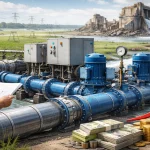
The pumping station is the central hub of the irrigation system. It determines the pressure and volume at which water will be supplied to the field.
Its operation determines:
- watering stability
- system energy consumption
- equipment resource
- operating costs
If the pumping station is incorrectly selected, the system may operate, but its economy will quickly deteriorate.
Errors in pressure calculation
One of the most common problems is incorrect pressure calculation.
When selecting a pumping station, the following should be taken into account:
- water lift height
- pressure loss in pipelines
- length of highways
- fittings and filtration
- working pressure of irrigation equipment
If these factors are underestimated, the pump will not be able to ensure stable system operation.
If the equipment is oversized, the system will consume more electricity than necessary every day.
Incorrect performance
Another common problem is that the pumping station's capacity does not match the actual needs of the system.
In irrigation systems, it is important to strike the right balance between:
- water source flow rate
- pumping station capabilities
- irrigation equipment requirements
If the pumping station does not provide the required amount of water, the farm is forced to operate with restrictions: run machines in turn or change the irrigation schedule.
If the capacity is excessive, the pump operates inefficiently and consumes unnecessary energy.
What to consider when selecting a pumping station
The correct selection of a pumping station begins with a comprehensive engineering analysis.
It is necessary to take into account:
- water source and its flow rate
- the difference in elevation between the water intake and the irrigation area
- length and configuration of pipelines
- working pressure of irrigation equipment
- prospects for expanding the system
- energy efficiency
Only after this can the optimal type of pumps, their number and the station's operating diagram be determined.
Steiner solutions for irrigation systems
Steiner works with engineering solutions in the field of pumping equipment and water supply systems.
In irrigation projects, the company can offer:
- analysis of the conditions of the object
- development of the technical concept of the system
- selection of pumping equipment
- design of pumping stations
- equipment supply
- system installation and commissioning
This approach allows the irrigation system to be viewed as a single engineering complex, where all elements work in harmony.
Conclusion
Irrigation in Ukraine is entering a new phase of development. After losing part of their centralised land reclamation infrastructure, many farms are forced to build irrigation systems from scratch.
In such conditions, the quality of engineering solutions becomes a decisive factor.
And the pumping station is one of those elements where mistakes are most costly. It determines the stability of water supply, energy consumption and the efficiency of the entire irrigation system.
Therefore, its selection should be considered not as a technical detail, but as a strategic decision for the economics of irrigation for years ahead.