
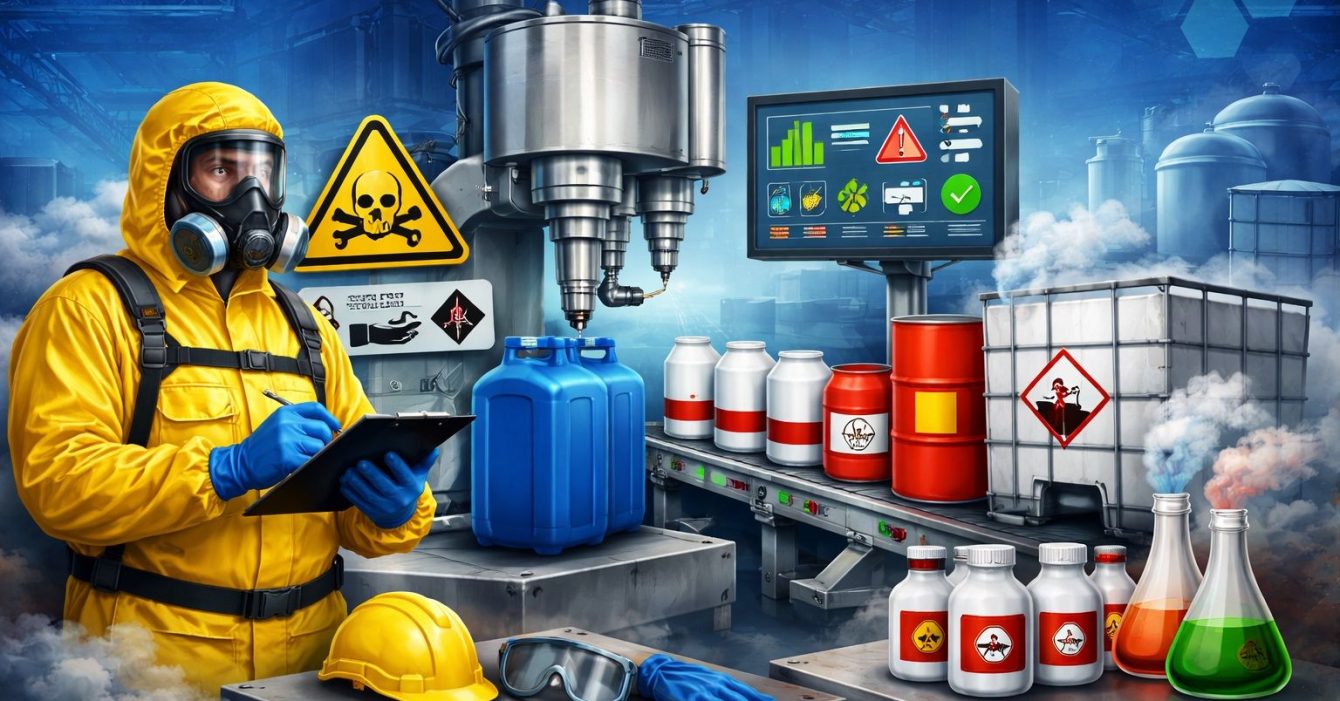
The production of household chemicals, fertilisers and industrial reagents requires a specialised approach to automation. Unlike the food industry, the key criteria for selecting equipment here are not only speed, but also chemical resistance and environmental safety. Steiner examines how modern technologies minimise risks when working with hazardous environments.
Why is standard equipment unsuitable for corrosive environments?
Working with acids, alkalis and solvents creates extreme conditions for machinery. Standard stainless steel is susceptible to pitting corrosion when exposed to chlorides or concentrated acids. This leads to leaks in the lines, resulting in environmental fines and health risks for staff.
Choice of materials: From AISI 316L to Hastelloy and PTFE
To ensure the durability of our filling lines, we use materials with enhanced resistance to chemical exposure. In addition to high-grade steels, critical components (valves, nozzles, pipes) are manufactured from fluoropolymers (PTFE), polypropylene or PVDF. These solutions ensure that Steiner equipment will maintain dosing accuracy throughout many years of operation.
Innovative dosing methods: Non-contact precision
Filling accuracy in the chemical industry is directly linked to safety. Excess product in the container can cause the bottle to deform due to gas release, whilst splashing during filling can damage the label or the conveyor belt.
- Mass flow meters (Coriolis): The most reliable method for corrosive liquids. As the measurement is taken without any contact with moving parts within the flow, the risk of failure is minimal.
- Vacuum filling (Negative Pressure): This technology is ideal for foaming detergents. It ensures that the neck of the container remains clean, which is essential for a secure seal.
Industrial safety and ATEX standards
Many corrosive substances are also highly flammable. Consequently, the design of packaging lines must comply with ATEX regulations. This is not merely a legal requirement, but the cornerstone of the plant’s stable operation.
- Explosion-proof version: Electrical components are housed in special overpressure enclosures or replaced with pneumatic equivalents.
- Vapour recovery systems: Each dosing station is fitted with extraction probes to prevent the build-up of harmful vapours in the work area.
- Tightness of sealed chambers: The working area of the line is enclosed by protective screens, creating a physical barrier in the event of an emergency.
How do you choose a reliable partner?
Investing in the automation of chemical production is a strategic decision. When you choose dosing systems from Steiner, you are not just getting a set of machines, but comprehensive engineering expertise. We take into account the product’s viscosity, its chemical reactivity and explosion protection requirements.


