
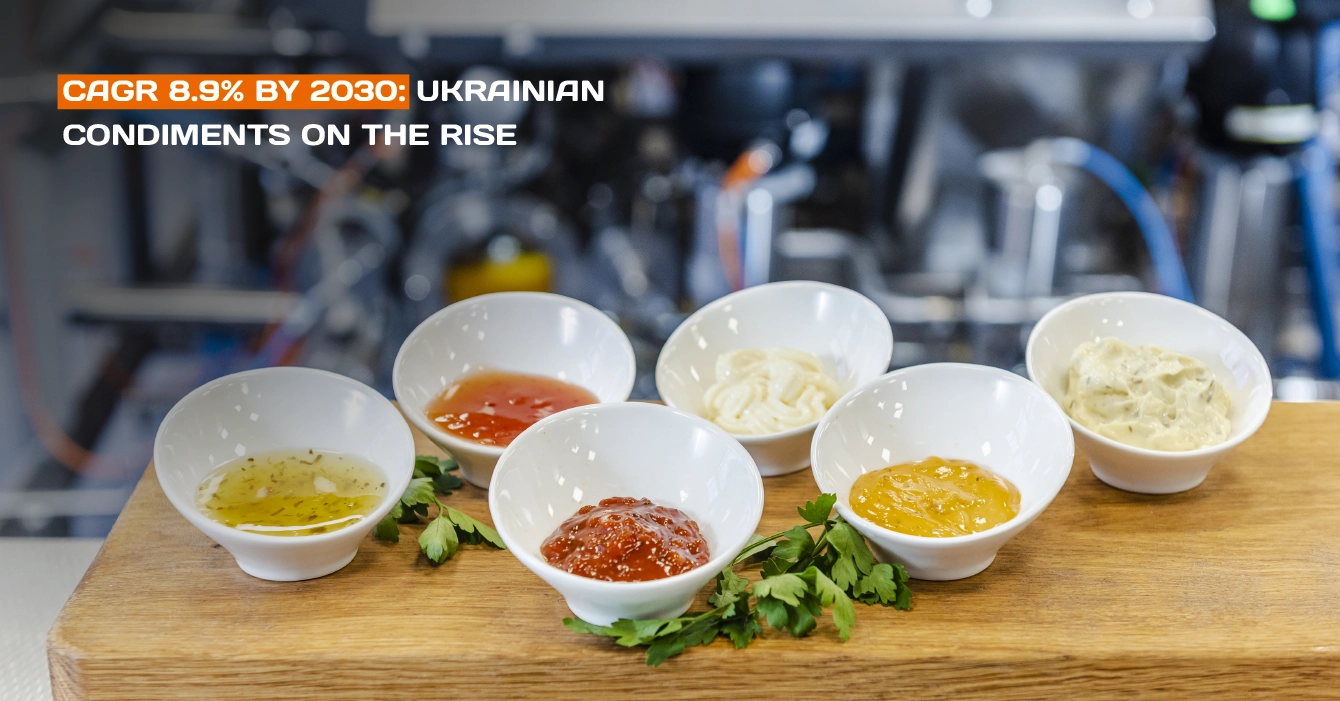
In today's world, sauces, mayonnaise and ketchup do more than just complement meals – they shape consumer preferences, influence health and reflect global economic shifts. In Ukraine, where the food industry faces geopolitical challenges, this segment is showing moderate recovery after the COVID-19 pandemic and military turmoil. According to Statista, in 2025, the e-commerce market for sauces and spices will reach $18.49 million, with a projected compound annual growth rate (CAGR) of 8.89% until 2030. Tomato ketchup, as a key sub-segment, will generate $4.09 million, with a CAGR of 7.69%. The total food market in Ukraine is estimated to reach $62.82 billion in 2025, with a CAGR of 8.97%. This article, based on current data from Statista, MarketsandMarkets and other sources, analyses market specifics, trends, production aspects, foreign trade, problems and development prospects.
Market Overview: Dynamics and Key Players
The Ukrainian market for sauces, mayonnaise and ketchup is part of the broader food industry, where local producers dominate, but imports play a significant role. According to Pro-Consulting analysts, the sauce market remained stable in 2023–Q1 2024, with a focus on recovery from the crisis. Key players such as Shchedro and Veres control a significant share, especially in the mass segment, while premium products are gaining popularity.
Mayonnaise accounts for 35–40% of the market, with an emphasis on low-calorie options. Ketchup, linked to tomato processing, is growing thanks to the recovery of the HoReCa sector: after a significant drop of 51.8% in 2020 due to the pandemic, the restaurant market has stabilised, stimulating demand for wholesale sauces. Overall, the industry has grown by 5-7% annually since 2022, thanks to home consumption and online delivery.
Trends: From Healthy Eating to Sustainability
In 2025, Ukrainian consumers are increasingly focusing on healthy and sustainable products. According to MarketsandMarkets forecasts, the global plant-based products market will reach $74.2 billion by 2027, with a CAGR of 11.9% from 2020. In Ukraine, this is reflected in the demand for plant-based alternatives, such as sauces based on pea protein or coconut oil.
Other key trends include:
- Healthy eating: Gluten-free and low-sodium sauces enriched with probiotics. Functional products are estimated to account for 3–5% of the market in Ukraine, with potential for growth.
- Sustainability: Using local raw materials to reduce carbon footprint. The zero waste trend – sauces made from fermented waste – is being tested by small producers.
- Innovations: Hybrid flavours, such as Ukrainian barbecue with elements of Asian sauces, for HoReCa.
These trends open up niches for exports, especially to the EU, where the sauce market is growing by 4–5% annually.
Production Specifics: Technologies and Equipment
Sauce production requires precision at every stage. Classification (white emulsified, such as mayonnaise; brown, such as bordelais; spicy chutneys) determines the processes: from reduction for concentration to emulsification for stability.
Main stages:
- Preparation: Grinding and juice extraction.
- Mixing: Dispersing oil with egg yolks at high speeds.
- Heat treatment: Pasteurisation for pH <4.6.
- Concentration and packaging: Evaporation for viscosity.
The equipment includes cooking kettles and twin-action mixers, which reduce processing time by 30–50%. Critical factors for scaling are viscosity (up to 5000 cps) and hygiene (EHEDG standards).
The Dutch company Selo offers automated lines for sauces, mayonnaise and ketchup, with batch and continuous systems. In Ukraine, Selo's official representative is Steiner Ukraine, which integrates equipment with local needs. For example, adapting lines with hot/cold filling increases productivity by 40% and ensures taste stability.
Read more about SELO
Exports and Imports: Trade Balance
Ukraine is a net importer of sauces: soy sauce imports reached $3.37 million in 2023. Total food imports increased, with China and the Netherlands as key suppliers. Exports grew by 15% from 2021, reaching $41.73 billion in total in 2024, with agricultural products to the EU accounting for $12.8 billion. Ukrainian sauces with local ingredients (e.g., paprika-based) are competitive in the clean label segment.
Challenges: Logistics, Inflation and Regulations
The industry faces barriers: the war has increased logistics costs by 30–40%, and a shortage of raw materials (tomatoes) has reduced production. Raw material inflation reached 15.7% in 2024. EU regulatory requirements (HACCP) require investments of UAH 5–10 million per line, while competition from Asian imports is putting pressure on margins.
Prospects: Growth and Innovation
The market shows growth potential of 8–10% in 2025–2027, with a focus on digitalisation (AI for recipe optimisation) and sustainability. Niche products such as vegan mayonnaise and exports to the EU (potential of $100 million by 2030) are key drivers. Investments in technologies such as Selo systems through Steiner Ukraine will help increase efficiency and competitiveness.
Conclusions: Development Strategies
The Ukrainian sauce market is evolving from tradition to innovation, with potential for global integration. Growth of 8% in 2025, health trends and technology are the basis for success.
Manufacturers should focus on adaptation and investment to overcome challenges.