
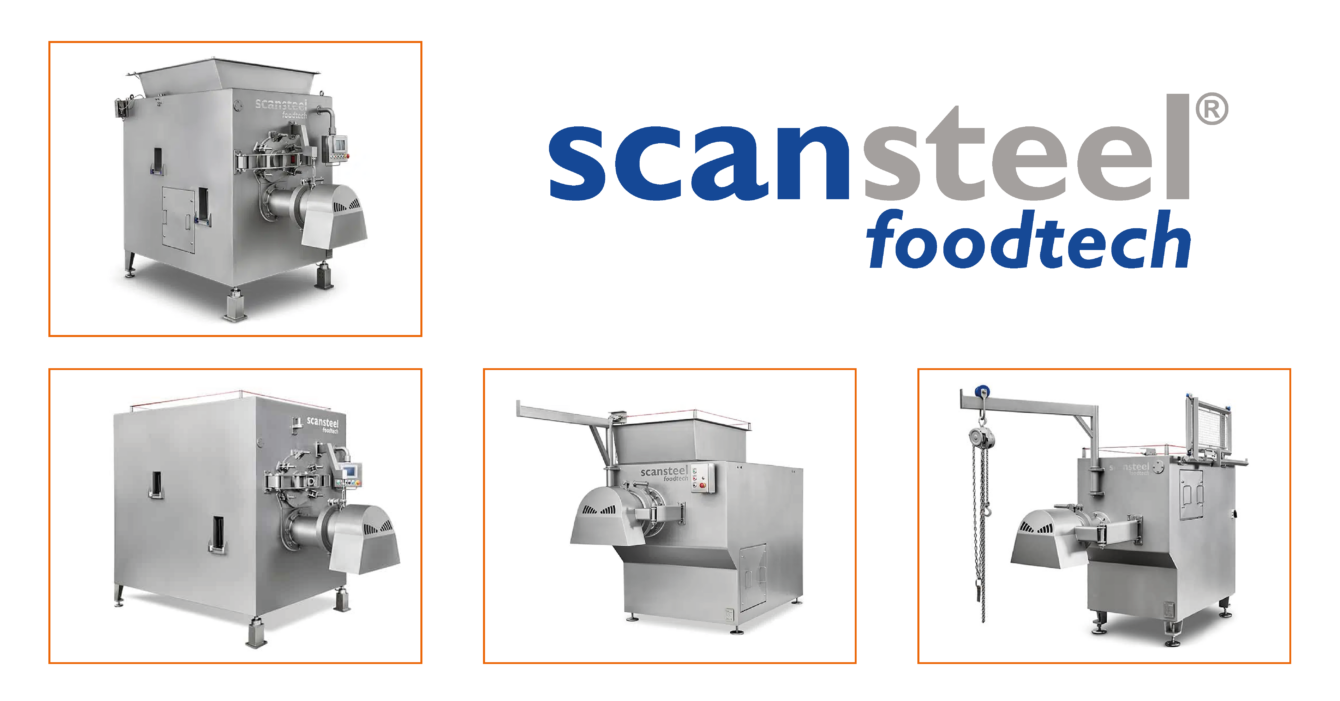
An industrial grinder in food or feed production is not just a "mincer." It determines the stability of the mince structure, fat concentration (risk of "smearing/fat out"), throughput at peaks, as well as how much downtime the line has for cleaning and servicing. That’s why when selecting a grinder, it’s important to look not only at the capacity but also at the type of auger, handling of frozen blocks, bones, hygienic zones, ease of disassembly, and safety.
Below is a practical guide using the scansteel foodtech program: single-screw and twin-screw grinders, as well as units for fine grinding/emulsification.
Important points when choosing a grinder: 4 critical parameters
- Raw materials and their condition: fresh meat raw materials / tempered / deep-frozen blocks / fat / fish / offal / by-products.
- Risk of smearing (fat spreading) and requirements for the ‘definiteness’ of fat particles in minced meat (especially for sausages, burgers, drying/curing).
- Performance and actual ‘peak’ operation, not average.
- Hygiene and washing: access to product contact areas, separation of drive units from the product, minimisation of cross-contamination risk.
Single-shaft shredders: when it's the right choice
Single worm/auger grinders are usually chosen when the following is required:
- reliable, simple grinding mechanism;
- working with fresh meat raw materials and/or frozen blocks;
- high throughput and predictable operation.
scansteel foodtech offers the following grinder specifications: stainless steel AISI 304, ranges Ø250–Ø550, capacity 2000–40,000 kg/h, as well as options such as hydraulic knife tensioning.

Twin-shaft shredders (CombiGrind): when they offer a real advantage
Double worm/auger conveyors are usually justified when the following is required:
- simultaneously work with ‘heavy’ raw materials (including frozen blocks) and maintain stable mince quality;
- reduce fat smearing and preserve the structure of fat particles;
- it is preferable to control the feed to the cutting sets by controlling the speeds.

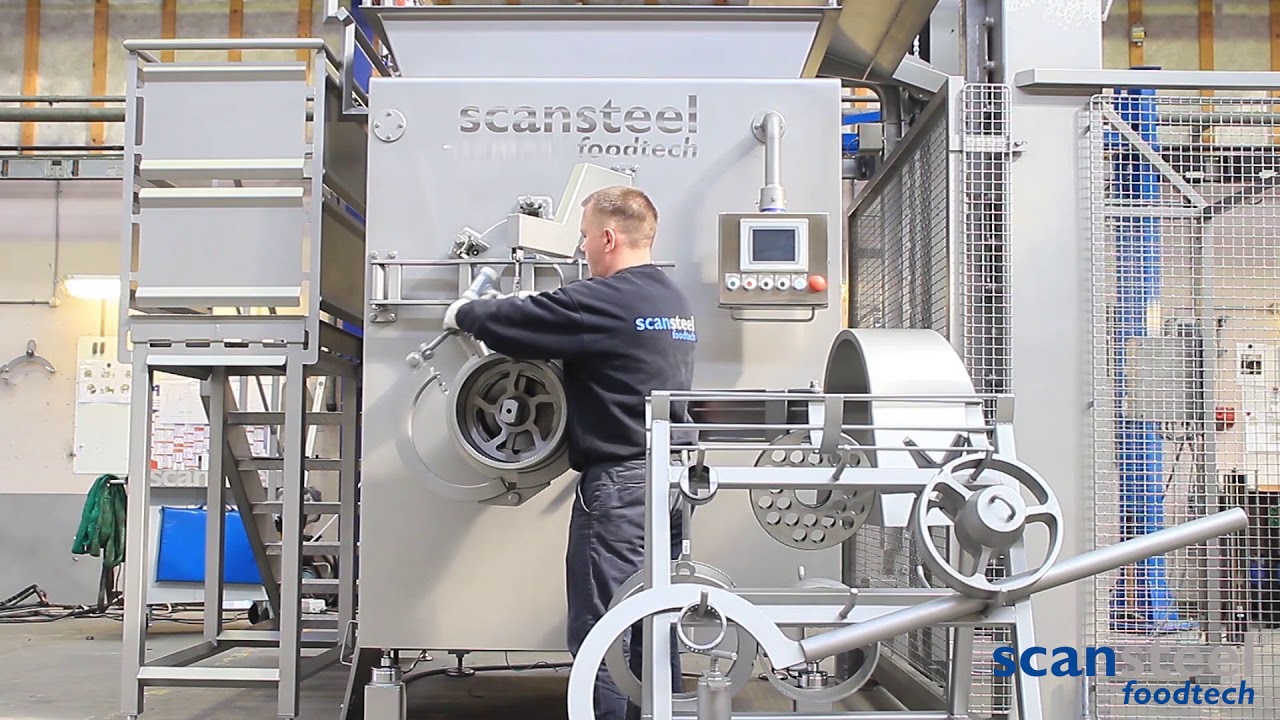
Fine grinding and emulsification: where the grinder ends and the ‘structure’ begins
In many recipes (pâtés, emulsions, some pet food formulas, sauces), grinding is only the first stage, followed by fine grinding/emulsification.
FE 250 (Final Emulsifier)
The FE 250 is described as a final emulsifier, which is fed by a pump or from an emulsifier; it is used where maximum particle reduction is required. The typical motors are 37–160 kW with capacities of 4000–20,000 kg/h.
MGX 400 (Cheese extruder, also for some ingredients)
The MGX 400 is positioned as a cheese extruder, with an output particle size of Ø2.8 mm or Ø5 mm and a capacity of "up to 12,000 kg/h", along with a list of options/features.


How to correctly formulate a request (technical specifications) for an industrial wolf: briefly and to the point
To ensure that the supplier provides the correct configuration immediately, the request should specify:
- Raw materials: type (meat/fat/fish), presence of bones, temperature (fresh/chilled/frozen).
- Block parameters (if any), feeding method, need to prevent ‘bridging’ in the hopper.
- Structure of minced meat: fineness/coarseness, criticality of fat ‘definition’, inadmissibility of ‘fat smearing’.
- Productivity: nominal capacity and peaks (kg/hour), operating schedule, power reserve.
- Washing/sanitary facilities: how COP/CIP is organised at your facility, availability of water/chemicals, requirements for downtime at the washing facility.